
How Should Autistic Characters be Written?
Neurodivergent representation: a study in three cases.

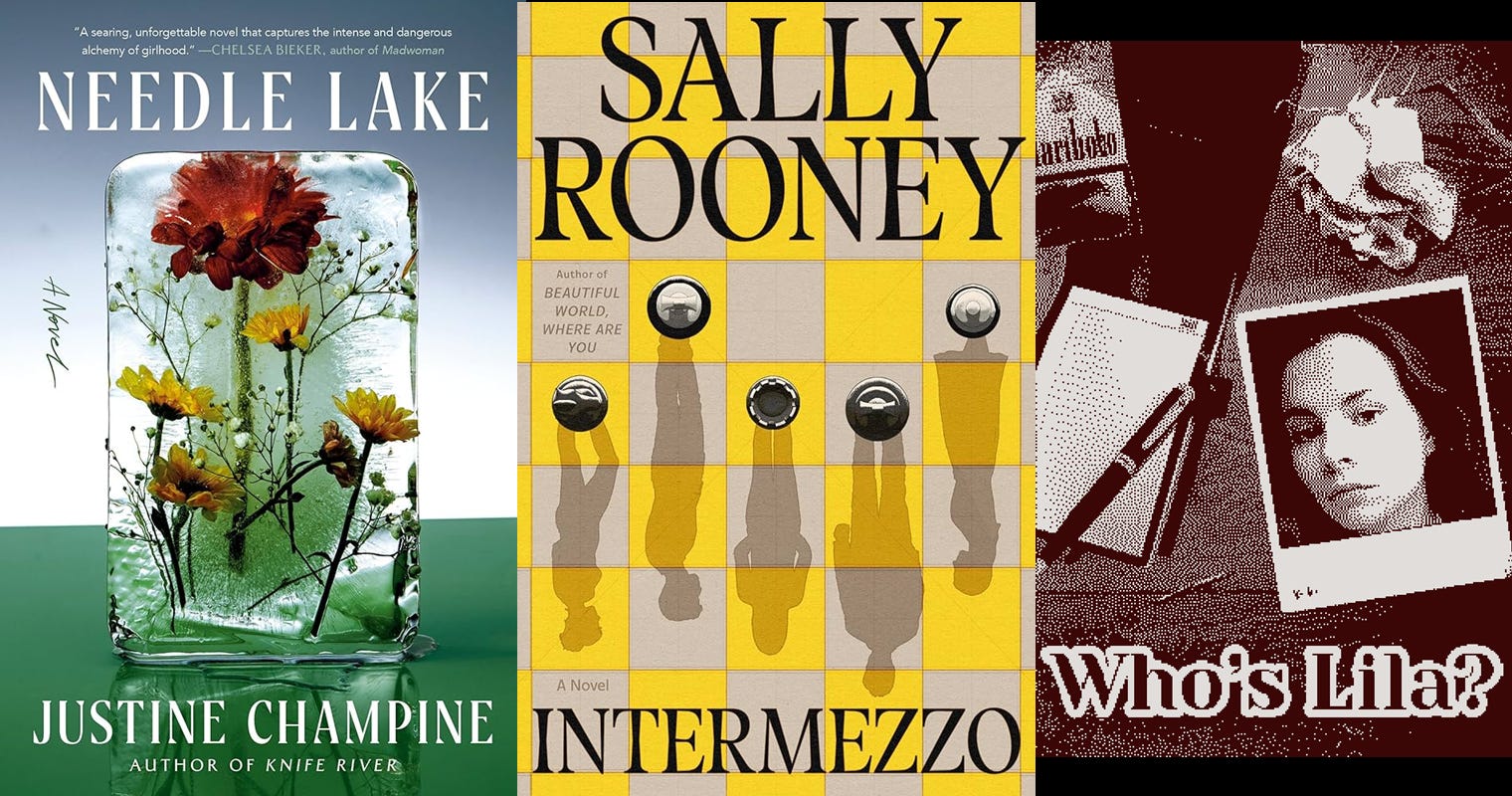
I’ve been reading a review copy of Justine Champine’s new novel Needle Lake, a surprisingly tender psychological thriller about a teenaged Autistic girl, Ida, who gets swept up in the fallout of a murder after her alluring and far more socially astute cousin, Elna, arrives to her tiny town.
Reading the book — which I fully enjoyed, and found almost triggeringly moving in some places — has got me thinking a lot about how Autistic characters are depicted in fiction, and the many choices authors have to make, if they want to do it well: whether to explicitly name the character as Autistic, for example, how much to make a character’s Autism a core component of their plotline and characterization, and how many other forms of neurodiversity the author wants (and has room to) consider.
I’ve been working on a novel with a teen Autistic protagonist for over a year now, so these are all considerations that have been weighing on my mind. I’ve also seen a lot of lackluster attempts at including neurodivergent people within a narrative work over the years, ones that reduce a character to a handful of stock Autistic traits or try too didactically persuade the reader/viewer/player that neurodivergent people aren’t really so different from the ‘rest of us,’ without meaningfully drilling into what that means about our collective views of normality.
But Champine has managed to create a realistic Autistic lead in her novel without making the book feel like a lesson, or like some kind of fanfiction that pats itself on the back for introducing the reader to the most thinly-drawn of underrepresented figures.
Ida gets to be a character, with other disabilities beyond her Autism that intersect with it, and inform how her Autism is interpreted. She masks, but often ineffectively, and numerous passages in the book are devoted to her sorting out the motives of other people effortfully, and failing to understand how to pilot her own inelegant body and face. She feels like an alien in her small town, and is lit up by passions that others cannot understand. At times her empathy falters, or operates differently from how other, more outwardly emotionally expressive people’s do.
I found many small details about the character recognizable, at times with shocking specificity. There were enough similarities between Ida and the protagonist of the novel I’m working on, Danika, that it sent me running back to my draft to remove anything that might feel derivative after Needle Lake’s release. (For instance, both protagonists happen to take solace in imagining themselves drifting at the bottom of a lake, removed from all the noise and confusion of being around human beings. I’ve scrubbed this detail from Danika’s characterization since reading Champine’s novel).
I am excited to see what Champine is doing in Autistic-written fiction and the impact it’s going to have on a variety of genres. It makes me feel hopeful that our voices can be present everywhere from literary novels to slasher movies to walking simulators and beyond, our differences not shortchanged or stereotyped, just simply understood as a part of human reality worthy of inclusion in art.
And I wanted to take a moment here to consider how Champine presents her (arguably multiple) neurodivergent characters, contrasting Needle Lake with two works of fiction that tackle Autism in very different ways: Sally Rooney’s 2024 novel Intermezzo, and developer Garage Heathen’s surreal and philosophical horror video game, Who’s Lila?
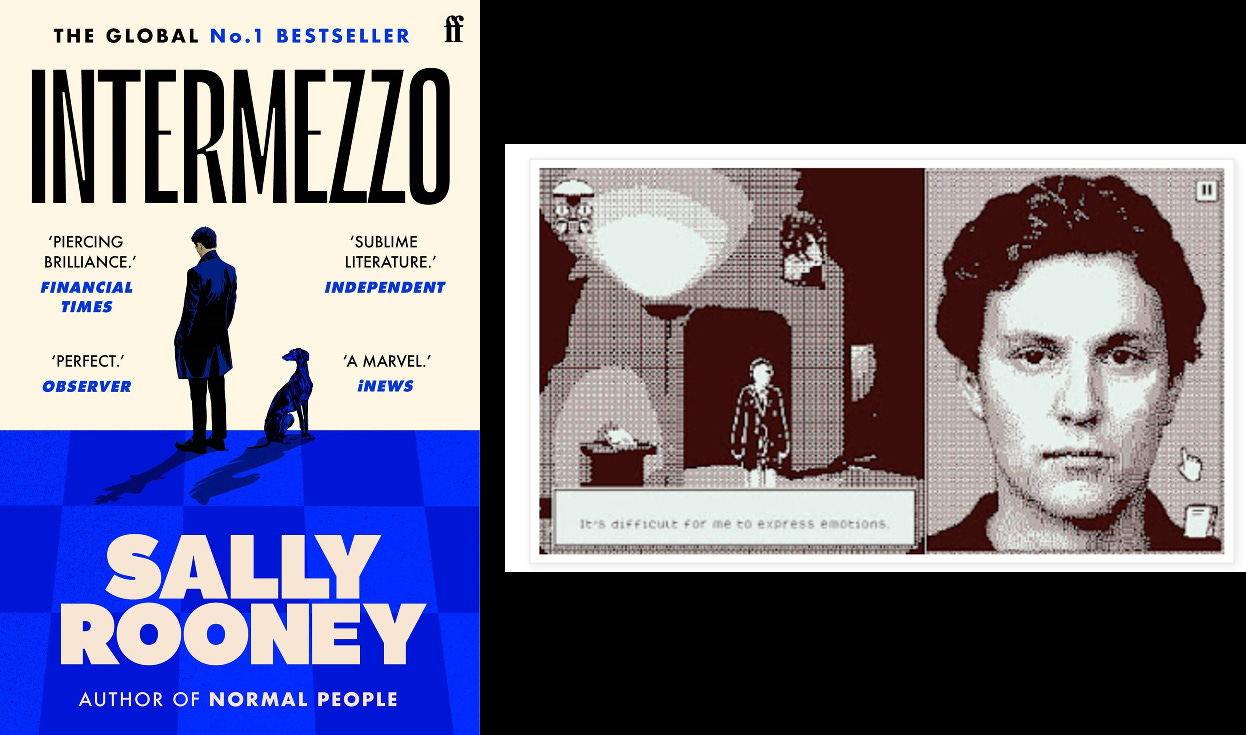
I will keep spoilers minimal as I discuss each of these fictional works, and describe how each of them approach the questions of whether to name a character as Autistic, how central to make Autism part of their characterization, and whether or not to include any other neurodivergent characters alongside them.
Is the character described as Autistic?
Needle Lake makes the neurodiverse representation within its pages quite clear, though nobody actually names Ida as Autistic (the closest anyone comes in the book is talking about how different she is, and calling her the r-slur).
Most readers will first become aware of the character’s neurodivergent status via the book’s positioning and promotion. Champine has intentionally selected Autistic writers (like me) to blurb her book, and was explicit to me about her intentions in writing an accurate representation of an Autistic girlhood like she experienced.
This information sets up a reader expectations for Ida right away. So when Ida says in the novel that she is friends with her teacher and feels cleaved off from the other girls at school, we know what that means:
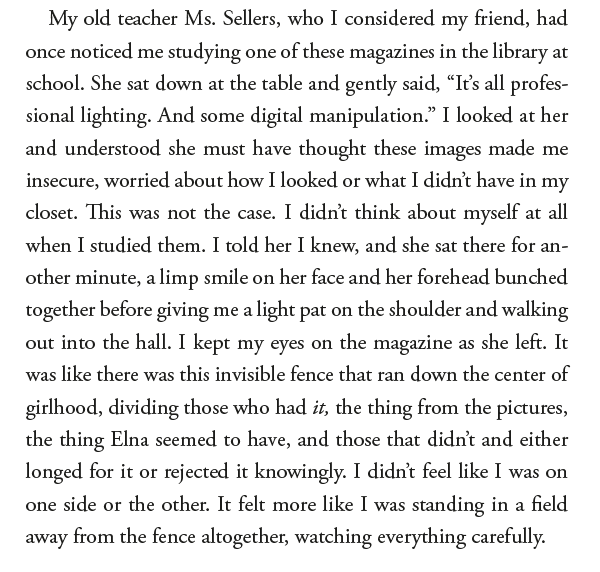
Importantly, because Ida is an undiagnosed Autistic teenager living in the 1990s, we as the reader know more about her situation and disability than she does. This helps the novel avoid a pitfall that many contemporary works fall into: by making characters far too self-aware and precise in the language they use to talk about their marginalization, many books remove all psychological tension, and make their stories feel like self-congratulatory homework with little emotional realism.
Neurodivergent characters are often a whole lot more interesting when they don’t fully understand or accept all of their inner workings, because so few of us actually do! They can’t bring their interpersonal problems to a tidy solution because they lack the tools. It is often far easier to get invested in a character who is on the brink of an important realization about themselves, but stabs in many of the wrong directions, than it is to follow someone who has got things figured out. Confusion, inner conflict, and missing information creates a whole lot more suspense.
I’ve chosen to make most of my fictional characters unaware that they are Autistic (or transgender!), because it’s far more engaging to watch a character be taken advantage of, misinterpret things, and lash out than to have them carefully explain why it is they do what they do and immediately find acceptance. The world I’m living in sure doesn’t work that way, and I find an authentic darkness far more enjoyable than comfort in my fiction.
(I also think there is far more narrative potential in a character at a turning point — one who’s lost in an alienation that could either right itself, or go tragically awry. People love characters with an unpredictable potential — it’s part of why so many trans stories are about people in egg mode, and why so many works of fiction are about teenagers).
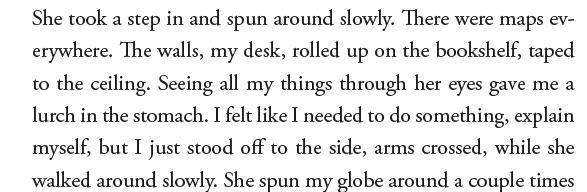
Because Ida is Autistic and masking but does not know that she is, her narration shows the genuine lostness that follows many unrealized Autistics for years. She recognizes that her actions around other people can become stilted and artificial, but she isn’t sure what normal-personal quality she is lacking and trying to make up for. And so even her own social personality is a bit of a blank; she’s more of a collection of defense mechanisms and self-denials around other people than an expressive person. Take this scene, when cousin Elna wanders into Ida’s map-covered room, and Ida feels shame at the obvious intensity of her special interest:
When neurodivergent people do not know that we are neurodivergent, we have a very difficult time making sense of how the social world operates or forming reliable predictions for what’s going to happen to us. Every moment of patience and kindness we do get is an unexpected reprieve, which makes us really easy to abuse. We might think we have found care and acceptance when we are just temporarily useful to somebody. And many of the strategies that we use to cope — the rulesets we follow, the ways we present ourselves, our outlooks on life — can be off the mark in ways that keep us more stuck, and that is interesting to read about, though maddening to live.
I haven’t seen many writers depict all of this as well as Champine does (though in a few, precious passages, Sally Rooney does accomplish a similar dramatic irony with the ADHDer protagonist of Intermezzo). Though at times Ida is able to describe her sensory preferences and mindset with a degree of self-awareness that’s a little hard to believe for someone of her era and age, in general Needle Lake shows us an Autistic character that does not know who she is yet, but makes sure that the reader can see her, and comprehend how her state of unknowing feels. The effect is both powerful and heartbreaking.
Sally Rooney’s Intermezzo is similar to Needle Lake in that it avoids having its characters self-describe as neurodivergent. For the most part, characters’ disabilities are implied through quirks in the narration and remarks that characters make about themselves in the dialogue.
It’s obvious within the first couple of chapters that a big part of Intermezzo’s conceit is that its primary POV characters are an Autistic brother and an ADHDer brother who can’t stop confounding one another. As readers, we quickly figure out from the fits and starts of Peter’s narration that he’s got ADHD. But while Peter’s neurodivergence is drawn from the inside of Peter’s head, Ivan’s Autism is informed to us, largely from an outside perspective.
Older brother Peter says early on that he sees Ivan as embarrassingly different, and difficult to deal with, unable to make it on his own. Peter is the one to name Ivan as Autistic and shows an interest in pathologizing his brother’s behavior that Ivan himself rejects. But even when Ivan does talk about his experience, he sounds more like a non-Autistic person’s impressions of (and annoyances with) him. His Autism is told and not shown, and it doesn’t even really feel like it’s Ivan telling us himself.
For instance, there’s this interaction, where Ivan tells his love interest Margaret that he knows he’s not a strong communicator:
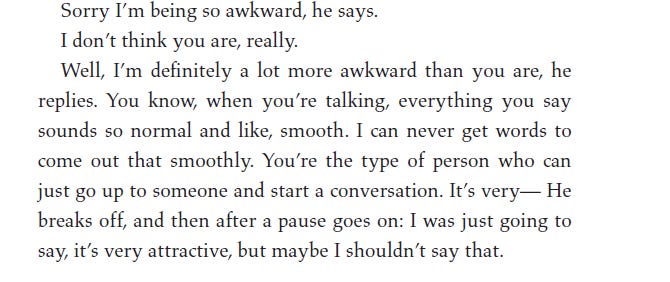
But Ivan says all of this about himself so knowingly and well! He’s so perceptive about himself, despite being a character who rejects self-consciousness in himself and anybody else. Rooney obviously wants to telegraph that Ivan is socially awkward, but rather than showing it to us, or letting us feel Ivan fumble, she has him state that he’s awkward and confusing in a message that could not be easier to follow.
Ivan’s Autistic characterization arrives to the book fully formed, and it never changes; he knows that he is bad at certain things, and is talented and independent in other ways, and despite of having very little interest in reflecting on himself, his perceptions are always accurate. It simply isn’t realistic. And it makes Ivan into a bit of a sagelike disabled figure instead of an impulsive and competitive young man with a soft side, which is probably more in line with what Rooney intended for him.
At many points in the novel, Ivan might as well be turning toward the reader and stating, I am very Autistic, you know. Here’s another example of Ivan clearly communicating that he is a bad communicator:
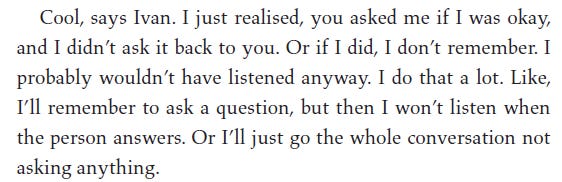
This passage sounds more like an allistic person complaining about Autistic rudeness than it does an Autistic person’s own feelings about their social experience. Does Ivan really care that he is a “bad” listener? He doesn’t attempt to mask it, or show self-consciousness about it. Yet he does take the time to draw attention to it. If he doesn’t care that he can’t listen well and doesn’t really want to change it, why is he bringing it up? Is it just so the reader makes sure to catch how Autistic Ivan is?
Rooney seems to really want to show that she’s done her homework on neurodiversity. She wants to get the intentions behind her Autistic, ADHDer, and (later, arguably) Moral OCD-afflicted characters across, but she telegraphs their disabilities so frequently and obviously that we don’t get much of understanding of what each character’s neurotype truly means for them.
And this is a damn pity, because Rooney has written conflicted, reactive, captivating neurodivergent characters in her books before — like in Beautiful World, Where Are You, a novel about a suicidally depressed best-selling author who cannot handle her fame.
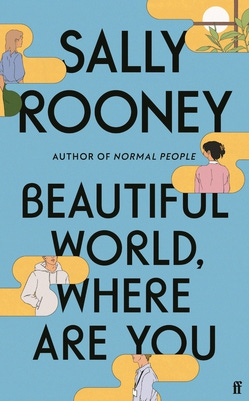
The protagonist of Beautiful World, Where Are You, Alice, is withdrawn and sad, but also viciously self-superior. She pulls away from her loved ones and leaves her home city, claiming to be on a break from all publicity for the sake of her mental health, then commits to a tour and media appearances without explaining herself or checking in with anyone in her life. She’s elusive about her fame and wealth, recognizing it as a liability, but also lords it over others when she feels threatened. She insults her friends, condescends to her lover, and melts down catastrophically in the book’s most shocking and cathartic moment.
Alice is a troubled, angry person who does not fully know herself, and that sends her knocking up against the novel’s other characters in fascinating ways. She proves that Rooney can write complicated neurodivergent characters who have their own mess of conflicting drives, and do it well. She just chose in Intermezzo to make her characters too obviously neurodivergent, and made a clear-cut rendering of disability too central to their identities.
In Intermezzo, ADHDer brother Peter’s consciousness is written as a series of random observations and anxious flashes that rarely come together into full sentences. I can see what Rooney is going for here: the reader gets to ride alongside Peter’s racing thoughts rather than have them explained to us. It’s nice to arrive at an understanding of Peter that nobody spells out, and it’s rewarding when you realize that so much of his judgement toward Ivan is a projection of his own neurodivergent shame.
But the effect Rooney uses for Peter’s narration is so heightened that it sometimes borders on the offensive, for me; it makes Peter a being of almost pure instinct, unable to even form thoughts:
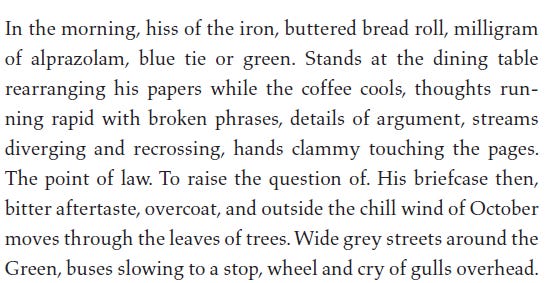
Maybe ADHDer readers will disagree with me about how this comes across. But I found Peter’s writing to be so hell-bent on placing ADHDer goggles over the reader’s eyes that it doesn’t always allow Peter to be a person with agency. For much of the book, it’s more like ADHD is one of the major antagonists, causing conflicts between Peter and others and driving him to take actions he can’t really understand and won’t look at directly. And so, as moving as some of Peter’s lowest moments can get, it often feels like the book agrees with the stigma that it explores.
One fictional work with an Autistic lead that I love is Who’s Lila?, a 2022 horror game whose protagonist, William, cannot form emotional expressions. The player must drag William’s face into expressions of happiness, fear, disgust, and anger throughout the game, and their accuracy determines the direction his conversations go in.
(For example, in order for William to get his classmate, Ellie, to tell him where to find his friend Martha, he first has to greet her with a pleasant smile, then look concerned when he asks where Martha has gone).
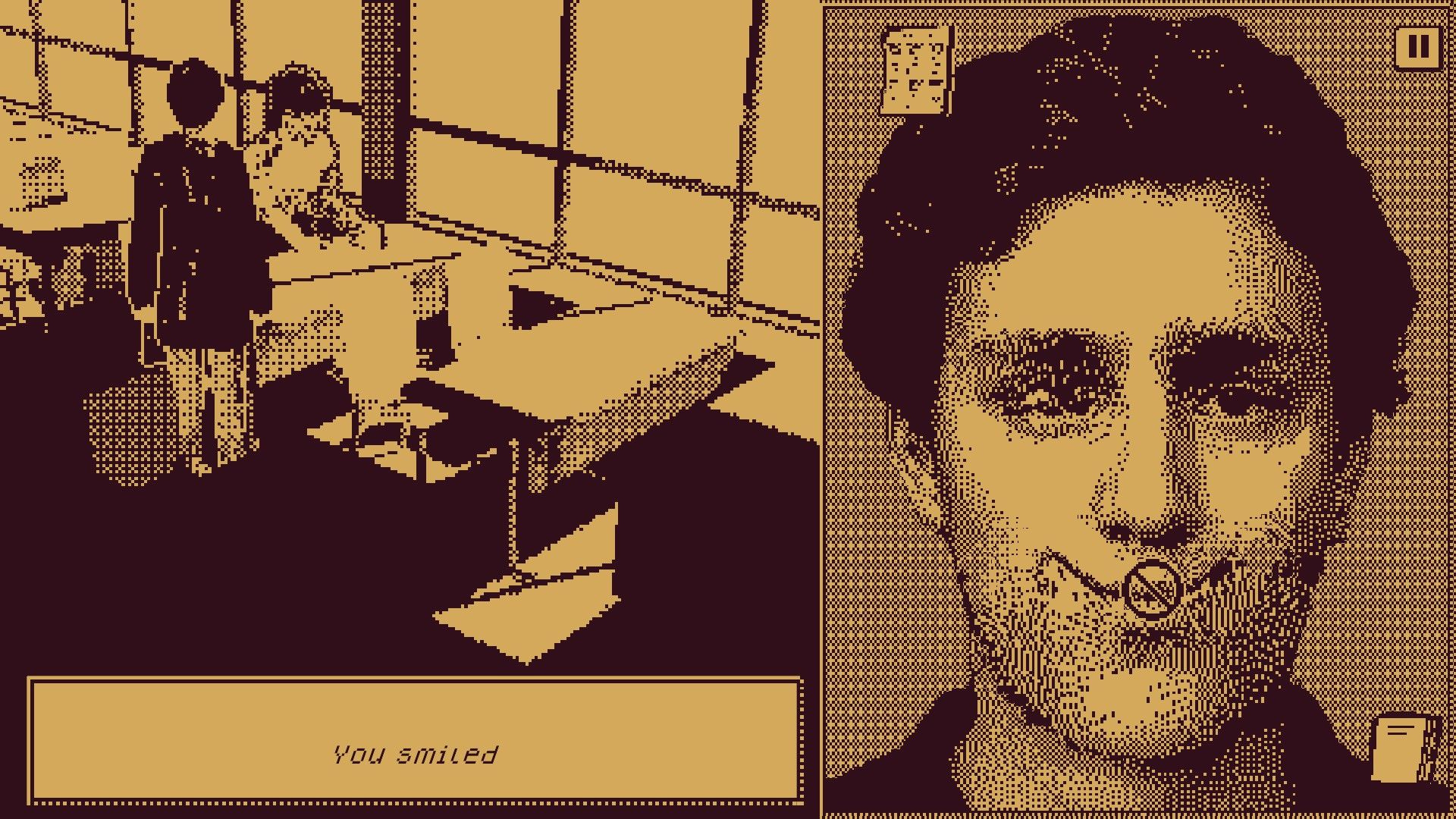
When William uses a facial expression that doesn’t match the social situation he’s in, other characters become suspicious, and sometimes even attack him. In the default difficult setting for the game, William’s face also twitches involuntarily, and sometimes flashes with inappropriate-seeming grins and frowns. The dissonance between William’s intentions and his social reception manages to be both creepy and devastating, and many an unempathic or alexithymic Autistic player will place themselves into his shoes.
William’s disability is written into the game’s functionality, so it never really needs to be explained to the player or named explicitly as Autism. Even a player with zero knowledge about neurodiversity can instantly grasp why Will’s life is so difficult, see how unfair and isolating his existence is, and understand why he’s come to associate with some of the unsavory figures that are his friends in the game.
In the game’s most stressful moments, the player is scrambling to make William see normal but mostly failing, perfectly replicating the actual pressures of masking Autism in real life. There is no dissonance between the text and the intended experience. You panic when Will is panicking, and wonder right alongside him whether there is something wrong in him that makes him smirk in the face of death.
In the opening scene of the game, Will is many days into playing hooky from school, avoiding the answering machine and the pile of trash moldering in his kitchen while he practices normal human facial expressions in the mirror. It’s a sad portrait, but one that says a lot using relatively little.
In Who’s Lila? Will gets to be a multifaceted version of a disabled person — unsettling, kinda pathetic, but also a dorky and lovable teenage kid who forms crushes and lies to impress the cool kids. His Autism is an inextricable part of him and people’s reflexive mistrust for him has shaped how his life has turned out, but he is more than just Autistic — and as the next section will explore, that is no small feat.
Is the character more than their Autism?
In Needle Lake, Ida is written to be a lonesome kid with a love of maps who bundles herself up tightly in blankets and hides in the closet to deal with stress. She is sheltered and inexperienced, even compared to her small-town classmates. During a period of overwhelm, she loses speech and has to communicate through written notes. When she is in an unfamiliar environment, she becomes quiet and deferential. She is deeply Autistic, and that comes through in all that she does.
But there is a whole lot more to Ida’s character than her Autism. She has another disability, a heart condition, which has meant she can’t play any sports and has to avoid exciting or stressful situations. This other disability has already clearly marked Ida as an other at school, and sets her apart, which makes it harder for her neurodivergence to be detected. Like so many masked Autistics, Ida is multiply marginalized, and that keeps people from showing much insight into her experience.
Ida hasn’t used any illicit drugs by the novel’s start, but she’s eager to try weed once she gets the chance, and settles easily into stoned relaxation. Like many an Autistic girl who longs to be more popular, Ida is also willing to break rules. She looks the other way when her charming cousin Elna steals and lies, and regularly ignores her own curfew (and her doctor’s advice) to go for brisk dives into the book’s titular lake. Later in the book, Ida has learned to lie and steal herself:
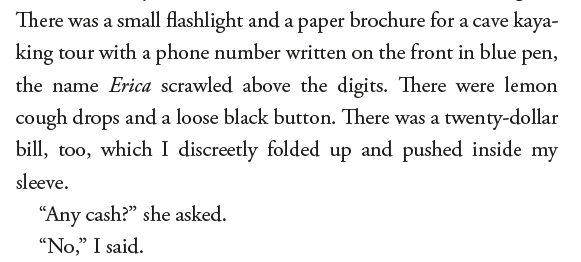
As a former Autistic “girl” who lied its way out of a shoplifting charge at age sixteen, I tip my hat at Champine for showing that disabled people can be rule-violators that enjoy a frisson of danger. I haven’t seen an Autistic character get to be a “bad girl” since The Queen’s Gambit, and Ida isn’t even all that bad. She just has a desire to fit in and experience life to its fullest, and is complex enough to be able to justify some amoral behavior to herself.
Ida’s biggest character flaws come from her being a lonely teen who wants to be cool, not from her being an Autistic person with a hole in her heart. At the same time, Ida’s Autism colors the form of her rebellion. She can’t be the popular, swindling Elna, who can manipulate everyone around her with the bat of a lash. Instead, Ida has to hitch her life to the coattails of someone more socially shrewd, and take advantage of opportunities when she finds them. In these ways, Champine gives Ida both freedom to make decisions, and realistic constraints.

It is this multifaceted flawedness that many of Rooney’s characters are missing in Intermezzo. Ivan is an Autistic character of a more stereotypical sort: he’s blunt, uninterested in most socializing, inexpressive, and prodigious at chess. He’s also thoughtlessly sexist and has forayed into the online alt-right and incel movements before the start of the plot. Yet Rooney also writes Ivan to be instantly, intuitively good at sex, and able to silence his prejudices the moment he meets a woman who is into him.
It can be interesting when an Autistic character shows some contradictions. For instance, when the stiff, monotone-voiced Abed from Community steps into a performing role and suddenly becomes a loveable, wise-cracking rogue, it’s an amusing surprise, and the viewer’s appreciation for his abilities deepens.
But Abed’s switch-up is justified, because we already know that he is obsessive about reenacting his favorite movies, so it feels earned. In Ivan’s case, it feels as though his relational problems just become irrelevant the moment he gets a girlfriend. The collected narrative effect is that the incels are right, and Autistic men are only ill-adjusted because they haven’t gotten a woman to love and care for them.
Ivan never gets to show any conflicted or even developed relationship to his own neurodivergence in the meantime. He simply exists, talented at chess and unbothered by other people’s silly emotions, and the monotone unflappability that used to drive his brother Peter crazy gets to be exactly what his OCD-having girlfriend Margaret needs to calm her down. Though he’s one of the main characters, Ivan comes across as less of a character and more of an object of pure Autism that other characters rotate around.
The ADHDer brother in Intermezzo, Peter, gets to have a richer relationship to his own neurotype and a many-layered personality with opposing drives that enrage even him. To outrun his anxiety he drinks, fucks, picks fights with his brother, and contemplates exploding his life. He’s an arrogant debate-team winner, a successful lawyer who has always measured himself by his conventional success, but he’s also suicidal about the fact he can’t attend to all his relationships well enough. Though Ivan seems (unrealistically) detached from caring about what other people think, Peter cannot stop judging himself, his brother, and his own relationships based on whether or not they are “normal.”
Peter is also kind of implied to be polyamorous, a trait Rooney handles with some much-needed compassion. (Though it is perhaps a bit on-the-nose that the character who is dogged by his own inability to choose between romantic partners is one with out-of-control ADHD). Though he can’t understand why he keeps ping-ponging between his ex, Syliva and his younger girlfriend Naomi (and indeed, can’t even accept himself enough to say that’s what he is doing), Peter is shocked to discover that both women in his life are completely fine with the arrangement. The biggest challenge for Peter turns out to be not that he is abnormal, but that he expects conventionality out of himself when nobody expects that from him.
Here’s Peter and Sylvia talking through their nonmonogamy:
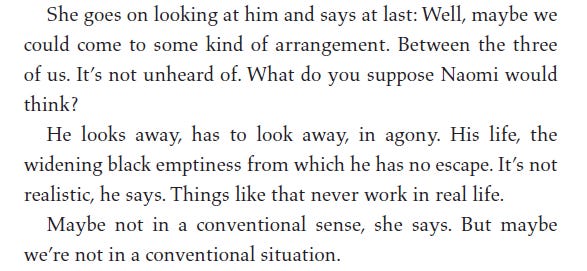
By the end of the book, Rooney has managed to give Peter a true arc that bends toward self-acceptance — and it’s really the emotional opening up of his relationships that makes this work, and feel satisfying. We get to see how his shame and masking have shaped the man he is, then watch it slowly dawn on him that his true self can be loved. It’s just too bad that the novel’s Autistic character never gets to have such a developed inner life.
Who’s Lila? gives Will a whole host of problems that have nothing to do with his being Autistic. He’s orphaned, for instance, and in his grief he has been preyed upon by a local cult. Though his unusual facial expressions do make some people respond to him strangely, Will does have friends who invite him to parties and at least tolerate his awkwardness. When he and classmate Tanya Kennedy experience a spark of attraction, Will gets to be a part of a love triangle straight out of any teen drama.
Will is weird and Autistic, sure, but he is able to socialize, find love, and navigate interpersonal conflict, and his tragic backstory is a bigger problem for him than his disability is. This helps ensure that in the narrative, Will’s strange expressions never make him into a monster. He’s just a guy afflicted with an unusual condition. Even the people around him can mostly understand that.
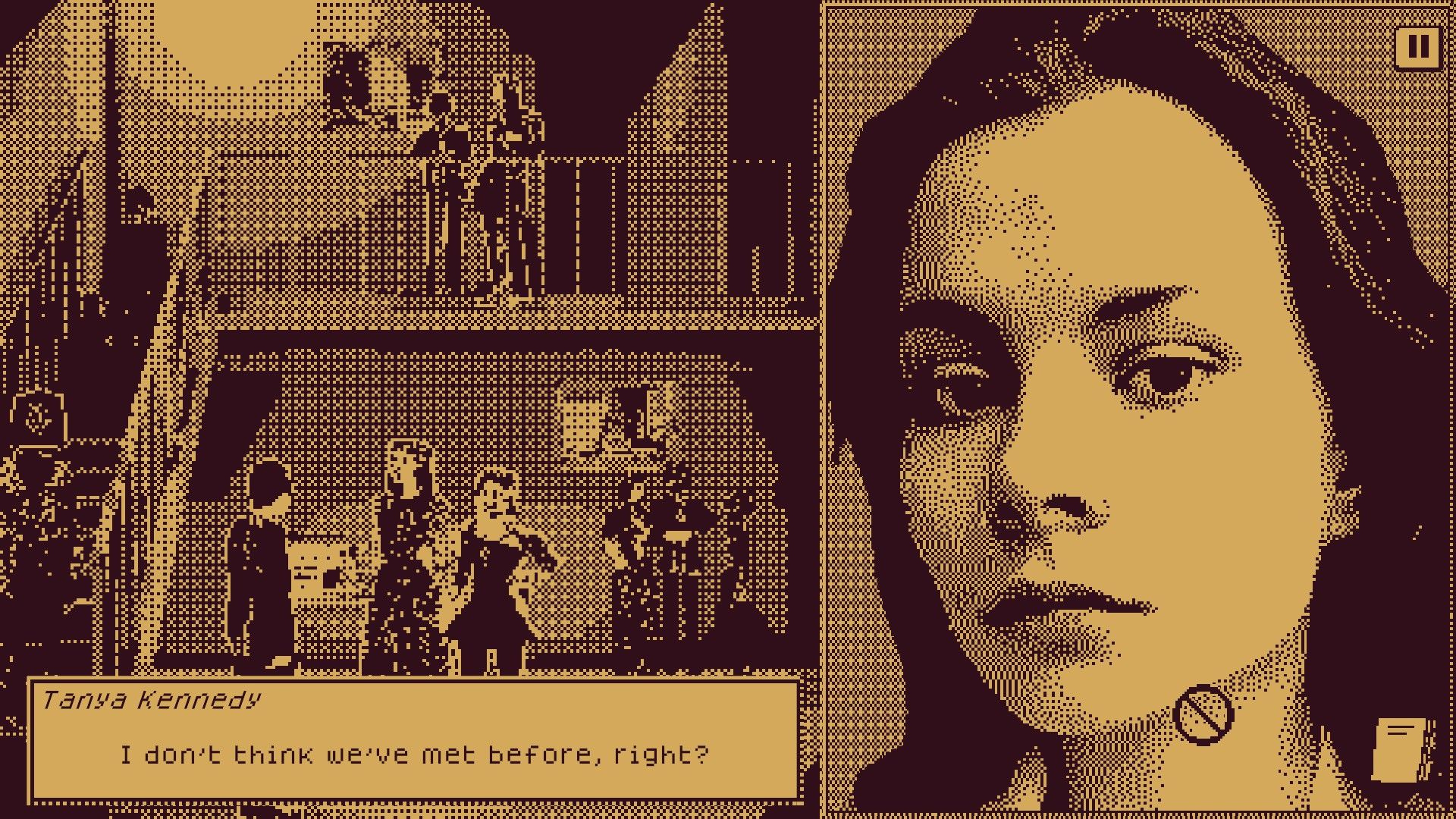
Eventually, Will’s neurodiversity becomes relevant to the plot, and it’s in believable, nuanced ways. For example, a few classmates who are initially pretty understanding toward Will’s lack of facial expressions turn on him once they have other reasons to think that he’s dangerous. Will’s acceptance was conditional, and he faces a higher degree of scrutiny and worse consequences for failure than people who can emote the “right” ways effortlessly.
Will also recognizes that his orphanhood and Autism make him more socially disposable, and that influences the choices that he makes. He’s jokey and casual, but elusive with personal details, and hedges his social bets by staying connected to his culty church and fair-weather friend without letting them know about one another. Will knows that he’s been one wrong step away from exclusion all along, but masks as more at ease than he actually is. A lot of Autism masking works like that, pretending to be less aware of one’s socially precarious position than one actually is. It’s quite brilliant that the writers of this game grasped that.
Will reads as an Autistic person with a whole life. Ida in Needle Lake gets to be really layered and historied as an Autistic character, too. By the end of the novel, we have learned about a family secret that has shaped everything about Ida’s living situation and relationships — and while her Autism has absolutely interacted with her life experiences, none of it has happened because she has a disability alone.
It is so rewarding when you can tell as a reader that there’s a detailed backstory to a character and their world that the author knows, but will only tell you so much about. And it is far too rare for Autistic characters to get to have a depth that invites re-reading and analyzing. It’s also rare for neurodivergent characters to be depicted in relationship to a variety of other neurodivergent people, even though in our actual lives we are surrounded by other disabled folks a majority of the time.
And that’s just one more way in which our three texts diverge:
Are there other neurodivergent characters?
As we’ve all increasingly come to learn, neurodiversity isn’t all that rare. The average person will meet a whole cast of Autistics, ADHDers, BPDers, NPDers, depressives, anxious people, OCDers, schizophrenics, bipolar folks, PTSDers and more in their lives, and statistically, a near-majority of people will go on to experience mental disability of some kind in their lives.
Neurodivergent people ourselves tend to have social lives that are dominated by other disabled people: we easily find and get along with one another, lurking on the margins of every social space that would rather not have us, and speaking a common language of coping and alienation.
Yet for all that neurodivergent people travel in packs, there’s usually only one of us in any work of fictional media. Even when an author puts care into depicting us accurately, we’re still often sidelined as the Very Special Lesson, the joke character, or the pitiable villain. It is a real test of a neurodivergent representation, then, to see how an author shows us in interaction with one another — whether they choose to populate their worlds with multiple neurodivergent people, and if they’ve considered how our traits and traumas might bristle against one another in all kinds of interesting ways.
It is in this area that Justine Champine’s Needle Lake shows some real intentionality, but occasionally frustrates. There are other characters in the novel that can be argued to be neurodivergent beyond Ida, but how much Champine wants the reader to clock this isn’t quite so clear.
There are multiple characters who are addicts, for example, but the novel doesn’t take much time to consider their interiority, or that their substance use is a form of neurodiversity all to its own. We see how other characters feel disgusted by them or frightened of them, which is certainly true to real life reactions to addicted people, but Champine doesn’t pause on this for enough time to generate skepticism.
Ida doesn’t see any relationship between herself as a “different” kid and these heavy drug users around her, and the drug users don’t get to speak up much for themselves, and so any potential reflection about mental health stigma that unites them never happens. Needle Lake is a short book with a really tightly paced second half, so it doesn’t make room for everything, but I think it would have been nice to see a character as curious as Ida to show a little more interest in the other people around her who are also viewed as strange failures.
There is also the case of Ida’s mother, a somewhat cold, practical figure who has fairly rigid expectations for her daughter and just might be a heavily masked Autistic woman herself. The more openly Autistic Ida’s behavior is, the more her mother is visibly put off by her, creating a distance between them that allows much of the plot to unwind as it does. Ida’s mother also has an analytical, laser-focused quality to her that suggests she is something other than an oblivious neurotypical. She seems to have her own system for making it by, and expects Ida to follow it, too.
This is a pretty common relationship dynamic in masked Autistic families: an older relative who never found acceptance as themselves often finds it difficult to accept their more openly weird, “embarrassing” Autistic kid, and might even envy them for the freedoms they have.
I don’t know if Champine’s intentionally hinting at this, or if I’m reading too much into a character who is emotionally uninvolved and not super detailed. But it sure would have been nice to see Ida and her mother reflecting on their relationship a bit more. At a few moments, the book comes close to considering how neurodivergence is passed along in families, but it never quite finds the real estate to get into it, which is a shame given how much the novel focuses on untold family histories.
There is one final character in Needle Lake who is discussed as neurodivergent, but they’re a bit hard to talk about. (I will be a bit vague to prevent spoilers here). This character is shown to be an effective abuser with a history that meets a lot of the criteria for a psychiatric diagnosis like anti-social personality disorder. The novel writes this character to be straight-up evil, with an ending that’s almost Disney-villain level cartoonish. But Champine also carefully mentions that when they were assessed by a professional, this character was found to be within the normal, sub-clinical range of behavior.
It’s not clear what Champine is trying to convey here. Is she contrasting the Autistic and well-intentioned Ida with a more easily demonizable, unempathic neurodivergent person? Or is this villain meant to be the face of neurotypicality?
It’s obvious that by having Ida preyed upon by this character, Champine is showing how neurodivergent young women are susceptible to manipulation. But since the novel’s main antagonist is so simplistically evil, and written to be both vaguely sociopathic and undiagnosed, it’s not really clear what the novel’s philosophy is toward forms neurodivergence that are “scarier” and more stigmatized than Autism.
As someone who rides hard for the narcissists, borderlines, and people without empathy, I’d prefer not to see evil chalked up to a person’s mental health status. I don’t expect ideological perfection in art, hell I don’t even like for my art to have a clear-cut “message,” but it’s a bit tonally strange for a book that depicts Autism with such nuance to give addicts and sociopaths so little. I think the main conflict in the book could have come from somewhere more interesting than that.

I’ve already talked at length about how Sally Rooney considers Autism alongside ADHD and moral OCD in her novel Intermezzo. Perhaps what is most frustrating is how cleanly she attempts to separate these categories from one another. Each neurodivergent character in the book is given their own unique narrative style, which is one of Rooney’s primary tools for illustrating what their disability is like to live with.
ADHDer Peter’s chapters flit impressionistically from topic to topic. Moral OCDer Margaret’s are filled with agonized worrying about what a terrible person she is, and failed attempts at justifying herself. Autistic Ivan is flat and matter-of-fact with occasional bursts of rage, though we rarely get inside his head. It’s as though these disabilities give the characters distinct operating systems that determine how they experience the world.
So what would Rooney make of the fact that it’s quite common for ADHD, Autism, and OCD to all go together? That the boundaries between these categories are actually incredibly shaky, and most ND folks could qualify for any one of them or all three diagnoses depending on the day? That many neurodivergent people obsessively catalogue and condemn their every perceived failure in an attempt to beat themselves into a socially acceptable shape?
Perhaps Rooney has contended with all of this and I just can’t see it. Many fans of the book have said that Intermezzo is a book all about overanalysis and obsession. Peter fixates on the ‘normality’ of himself and other people to a fault. But it’s implied throughout the book that Peter is, in fact, not “normal,” just as he fears, and will only get better once he’s able to accept it. But does Rooney’s writing reject that there are, ahem, any Normal People? I’ve read all of her novels, and I still cannot tell.
Personally, I think that if a narrative is going to seriously consider the spread of neurodiversity, it cannot treat its characters like archetypes of disorder labels. And so while I think what Rooney is aspiring to do with Intermezzo is interesting and has some emotionally affecting moments, it winds up reducing its leads to the disorders that they have, and does those disorders a disservice.
In a novel that’s all about internalized shame, it’s unusual for the lonesome Autistic character to harbor almost zero self-doubt. Rooney can understand how her ADHDer character feels conflicted and goes to great lengths to hide what’s different in himself, but almost every Autistic person feels that way too. Most adult Autistics are profoundly suicidal, and a huge number of them have ADHD too. We can’t really contrast the ADHD personality type and the Autistic personality type. And if we tried to, we certainly wouldn’t conclude the Autistic one harbored less neurosis or shame.
If Rooney had managed to infuse the book with a variety of neurodivergent perspectives, Ivan’s almost superhuman self-acceptance would not be a problem. But instead of featuring a whole cast of interacting neurodivergent people, Intermezzo gives us three tokens of specific disorders, and neither the reader nor the characters gets to find much commonality between them. There are some great arguments between Peter and Ivan that feel authentic to fraught, mixed-neurotype familial relationships, but outside of these clashes the characters are atomized, put on display for the reader’s observation rather than living in relation to one another.

Who’s Lila? is, I think, the most sophisticated of all three works when it comes to showing how various neurodivergences can intersect — both within a single person and in relationships. I won’t spoil the game, but I can say it’s heavily implied that beyond the Autism that’s been a feature of his life forever, William goes on to develop some other experience of self-hood that could be mystical, symbolic, or psychiatric, depending on how you interpret it.
Refreshingly, this never feels like mental illness is being used as a schlocky narrative device. The character Will is just going through something intense that knocks his identity loose from the universe, and of course his unstuckness from reality deepens the alienation he already felt as an Autistic. William has never understood the rules that guide “normal” human behavior, and his loneliness has primed him to be interested in finding alternate worlds and alternate selves that he could step inside of.
Multiple characters in the game have a confused relationship to identity: there are doubles, look-alikes, and body-swapped personas, each of them representing a person who feels detached from the mask they present to the world, or who questions the nature of their reality. Tanya is initially drawn to Will because he can see through her popular-girl surface and recognize her darkness. Tanya herself bears an uncanny likeness to the game’s titular Lila, a mythological and reality-bending figure that it would be a massive spoiler to even try to explain.
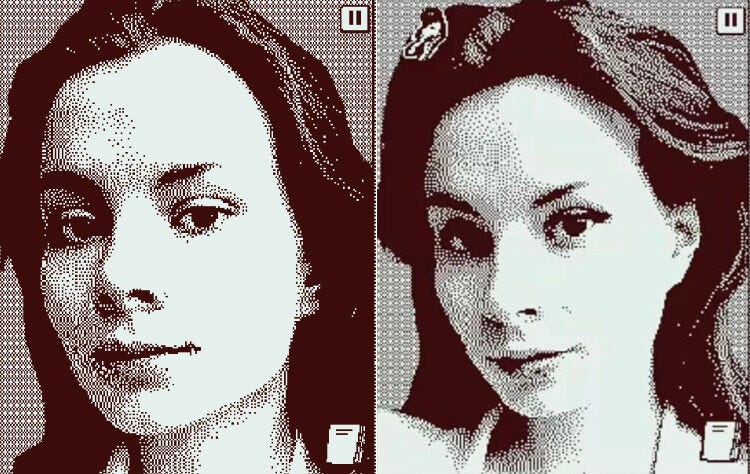
There really isn’t a character in Who’s Lila? who isn’t disturbed. Will’s classmates have explosive rage issues, easily exploited insecurities, and powerful death drives — like so many teenagers do in the real world. All of the cultists harbor delusional beliefs they’re willing to defend with violence, and possibly even die for. One character is convinced that he’s god, and might even be right. Almost everyone is impoverished and traumatized, which only heightens their desperation.
As the player, you get pulled into Who’s Lila?’s crazy-making universe; the game is literally a cognitohazard that puts ideas into your mind that can’t be taken out. Yet the game never mines mental illness for horror. If at first the player found Will to be out of touch and creepy, by the end they can see that he has a better understanding than anyone who is trying to be functional in his awful crapsack world.
Though the game mechanic of controlling Will’s face creates a lot of body horror moments, and Will himself gets involved in some seriously disturbing situations, Who’s Lila? never implies that mental illness makes a person dangerous. The characters are victims of extreme circumstances of psychological terror, but they always get to make decisions about how they will cope with the reality they’ve been thrown into, and the game doesn’t condemn their choices. Nobody is a straightforward villain in Who’s Lila? — and nobody is considered too unwell to be listened to. It is a marvel, especially in a genre like horror where neurodiversity is rarely treated respectfully.

Needle Lake, Intermezzo, and Who’s Lila? are wildly different works that set out to accomplish very different things, but they each show how neurodiversity can be incorporated into a narrative that isn’t just about Autism.
Needle Lake shines in its depiction of not-yet-realized, masked adolescent Autism and its blending of thriller with tender coming-of-age story. Intermezzo aims high, examining multiple related disabilities against the anxieties of contemporary life, and has some really valuable things to say about shame. Who’s Lila? imagines that we can mine nightmarish life experiences for psychological horror without ever demonizing the illness that often results. None of these are works that our community could have expected even ten years ago, and the Autistic & literary canons are better for them being here.
As hard as I can be on some of these works, it’s because I am spoiled for Autistic voices in media these days, and our community’s standards have risen. We’ve had an Autistic muppet for a decade now! Homie of this blog Jesse Meadows had an essay about neurodiversity featured on Nathan Fielder’s show The Rehearsal! Actual Autistic people are all over Netflix and Drag Race! In this landscape, we get to be critical of stories that smooth over our complexities, and dream of what the next generation of Autistic art will look like.
For my part, I want to see more stories in which Autistic characters start conflicts, give into their basest motives, go insane (complimentary, derogatory), self-destruct, find redemption, and confound simple categorization.
I want to continue seeing us taking a central role in literary fiction, genre epics, and interactive arts like theater and video games. I want more creative work about the darker sides to Autistic life, about how it feels to never recognize another person’s emotions, or to compulsively self-harm, or harbor an eating disorder from which you might never escape.
I want us to be sexy bad guys that viewers root for, like so many beloved queer-coded villains, and for us to play heroic roles that have nothing to do with being good at puzzles or math. I want a deep, rich consideration of all that our community contains, but one that spits in the face of respectability — Autistic art that will challenge and inspire fervent debate including among Autistics ourselves.
Maybe if I’m lucky, I will one day get to make some art like that. Texts like Who’s Lila?, Intermezzo, and Needle Lake certainly inspire me to flex my fiction-writing muscles again — and to not see my love of fictional writing and my neurodiversity work as separated.
Interesting to read this generous take on Intermezzo and the fact you gave more credit to Rooney than I was willing, but then maybe I'm just a begrudger ;) https://disabilityvisibilityproject.com/2025/01/31/rain-man-for-millennials-and-other-adventures-in-ableism-with-sally-rooney/
We need all types of GOOD neurodivergent representation, by neurodivergent authors, showing the full range of the spectrum.
I’ve read a lot of memoirs by neurodivergent authors, articles, fiction, and non-fiction books, and some of them really resonate with me, and some of them don’t at all. It means so much when you can see a part of yourself reflected in another person’s work. It’s really helped me become comfortable in my own skin and and develop my true identity as a late diagnosed individual.
Thank you for this case study. I truly hope it contributes to an improvement of neurodivergent characterization in the media.